Structured Intuition: How Spatial Thinking Transforms the Psychology of Elite Australian Play
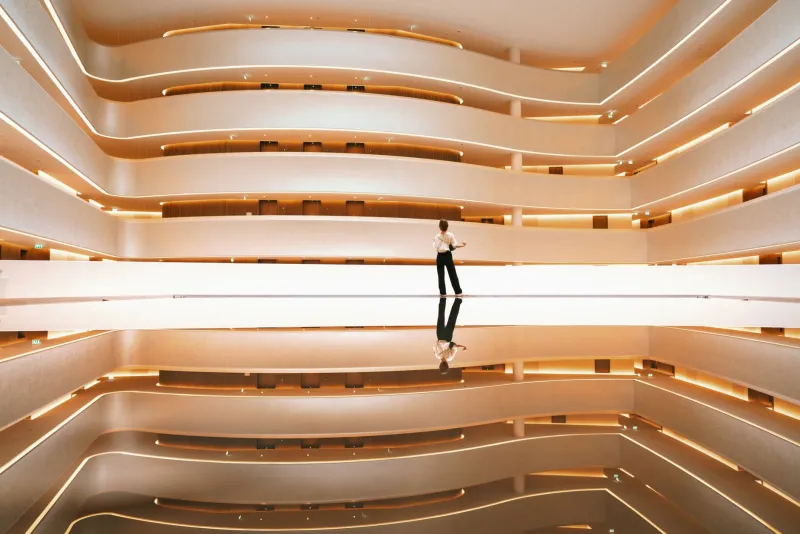
There is a certain kind of player who enters a gaming environment and, before placing a single wager, pauses. Not from hesitation. Not from uncertainty. The pause is deliberate — a quiet act of spatial calibration that the uninitiated might mistake for distraction. In reality, this player is doing something architects and sculptors have practised for centuries: reading a space before committing to action within it.
Among Australia's most accomplished casino players, this instinct is neither accidental nor mystical. It is the product of a refined psychological framework borrowed, consciously or otherwise, from the disciplines of architecture, contemporary art, and spatial design. Understanding how geometry shapes psychology — and how psychology shapes profitable play — offers a genuinely distinctive lens through which to examine decision-making at the highest levels of the game.
The Invisible Grid Beneath Every Decision
Geometric thinking, at its core, is the practice of perceiving relationships between points, boundaries, and movements in space. When an architect drafts a floor plan, every wall, corridor, and threshold serves a function beyond the aesthetic: it directs flow, creates tension, and signals transition. Elite players apply a strikingly similar logic to their betting patterns.
Consider how a disciplined player maps their session. Rather than approaching a game as a linear sequence of wagers, they perceive it as a field — one with zones of high exposure and zones of relative shelter. Aggressive bets occupy one region of this mental map; conservative positions anchor another. The movement between them is not random but deliberate, mirroring the way a skilled architect balances open space against enclosure to produce an environment that feels both dynamic and composed.
This spatial metaphor is not merely decorative. Research in environmental psychology consistently demonstrates that physical surroundings influence cognitive performance. The proportions of a room, the positioning of light sources, the density of sound — each variable exerts measurable pressure on the quality of human judgement. Australia's premier gaming venues understand this implicitly. The finest establishments in Sydney and Melbourne are not designed for spectacle alone; they are engineered to produce particular cognitive states in their guests.
Venue Design as a Psychological Instrument
The architecture of a premium casino is, in the most precise sense, a form of applied psychology. High ceilings and generous sightlines have long been associated with expansive thinking and reduced anxiety — conditions that favour considered risk-taking over reactive impulse. Conversely, low-lit, compressed spaces tend to produce urgency, which serves the house rather than the player.
Elite Australian players who have cultivated spatial awareness learn to interrogate their environment before settling into their preferred game. They seek positions that afford clear sightlines and physical ease. They avoid corners and crowded adjacencies that introduce unnecessary sensory noise. In doing so, they are applying, instinctively, the same principles a gallerist employs when deciding where to hang a significant work — ensuring that the surrounding space serves rather than diminishes the subject at its centre.
For those who engage primarily through online platforms, this spatial intelligence translates into the deliberate construction of a personal gaming environment. The choice of desk, the calibration of ambient lighting, the elimination of peripheral distractions — these are not trivial preferences. They are architectural decisions that shape the mental conditions under which every bet is placed.
Geometric Patterns in Bankroll Architecture
Beyond the physical, geometry offers elite players a structural model for managing their bankroll across a session. The most sophisticated practitioners do not think in terms of flat units or arbitrary percentages. They think in proportional relationships — ratios that echo the harmonic divisions employed by architects since antiquity.
The golden ratio, for instance, has found its way into the staking frameworks of more than a few analytically inclined players. Whether applied precisely or approximated intuitively, the principle of proportional scaling — where each commitment to risk bears a coherent relationship to what precedes and follows it — produces a kind of aesthetic coherence in the session's financial shape. Losses do not feel catastrophic because they are proportionally anticipated. Gains do not produce recklessness because they are contextualised within a larger structure.
This is not superstition dressed in mathematical clothing. It is the application of a proven design principle — that coherent proportion produces stability and clarity — to the domain of risk management.
Personal Space as a Competitive Advantage
Perhaps the most underappreciated dimension of spatial thinking in elite play is the concept of personal space as a competitive resource. Experienced players speak of the importance of psychological perimeter — a kind of invisible boundary that separates their decision-making process from the noise, energy, and emotion of those around them.
In a live setting, this manifests as controlled posture, measured breathing, and a deliberate narrowing of sensory attention. In an online environment, it demands the active management of one's digital surroundings — notifications silenced, secondary screens closed, the session framed by rituals that mark its beginning and end with the same intentionality a painter brings to preparing a canvas.
The geometry of restraint, then, is not simply about how much space a player occupies. It is about how precisely they define and defend the cognitive territory within which their best decisions are made. Australia's most formidable players understand that clarity of mind is not a gift bestowed by fortune. It is a space that must be designed, maintained, and protected — one carefully considered boundary at a time.